Kulturforum
Since the 1960s, the Kulturforum has evolved into a place that has shaped Berlin’s cultural identity like few others. Nestled amongst iconic buildings such as the Philharmonie, the Neue Nationalgalerie and the museums of the Staatliche Museen zu Berlin, a cultural hub has emerged whose influence extends far beyond the city. With the construction of berlin modern, the spatial and functional centre of the site is changing once again – and this also places new demands on the public space. New pathways are emerging, sightlines are opening up, and the Kulturforum continues to evolve into a vibrant meeting place where architecture, significant collections and a multi-layered history come together.
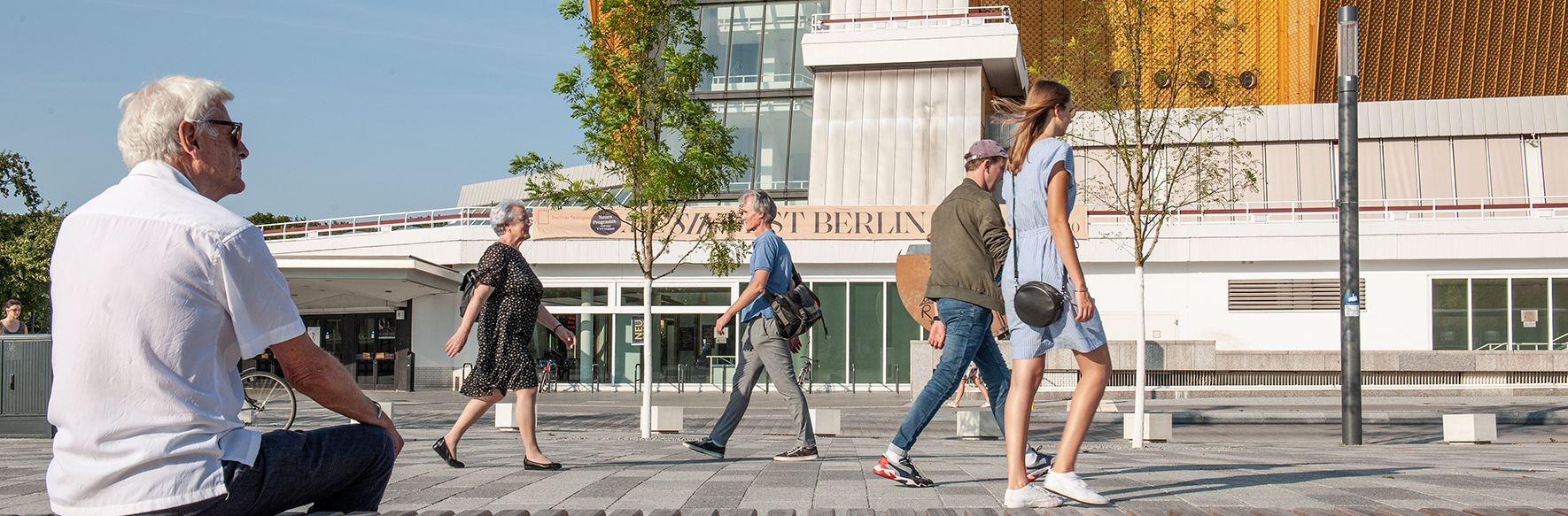
With this in mind, the original masterplan from 2005/2006 was comprehensively updated and progressively expanded by the State of Berlin. Since 2010, Grün Berlin has been overseeing the further development of the Kulturforum on behalf of the State and has implemented key construction phases in recent years. These include, among other things, the redevelopment of Herbert-von-Karajan-Straße, the redesign of the eastern forecourt of the Philharmonie and – as a major milestone – the redesign of Scharounplatz, which was opened to the public in 2019. These projects have impressively demonstrated how essential an integrated, sensitively coordinated approach is in this challenging urban environment. At the same time, they form the basis for anchoring current requirements – ranging from climate change and new mobility needs to complex construction projects such as ‘berlin modern’ or the refurbishments of the Philharmonie, the SIM/MIM and the State Library – within a coherent overall framework.
In close collaboration between the federal institutions involved, the relevant Senate departments, the Mitte District Office, the State Office for the Preservation of Historical Monuments, and the surrounding cultural and academic institutions, a consensus plan was drawn up in 2025 – coordinated by Grün Berlin – which was adopted by the Senate as the “Kulturforum Master Plan”. Today, it forms the overarching framework on which diverse interests are brought together and a clear development strategy is formulated.
At the heart of this reorientation lies the “heart” of the Kulturforum: Scharounplatz, Johanna und Eduard Arnhold Platz and Matthäikirchplatz. These three squares are to become a cohesive, inviting centre – with more greenery, shade and open spaces that enhance the quality of the environment and noticeably improve the microclimate.
Furthermore, the masterplan enhances the entire site in three key ways: Firstly, pathways are to be made simpler, safer and more accessible, so that visitors can reach their destinations more quickly and cultural institutions are easier to access. Secondly, the open spaces around berlin modern are being brought closer together – transitions feel more natural, spaces flow into one another, and facilities become more visible. This not only makes it easier to get there, but also strengthens the location. Thirdly, new access points to the Tiergarten and the Landwehr Canal open up the space towards green areas. This improves ventilation, noticeably cools the site in summer and makes it more attractive for both Berliners and visitors.
These guidelines are brought to life through twelve jointly developed key measures for an urban space that is permanently strengthened ecologically, functionally and economically.
They form a vision for a Kulturforum that is open, robust and sustainable – a place that makes cultural offerings more visible, actively addresses climate challenges and welcomes people from Berlin and all over the world.
Implementation begins at Matthäikirchplatz: new trees, green spaces and smart rainwater management create a pleasant microclimate here, make the square more versatile in its use and strengthen its connection to the surrounding area. Step by step, a Kulturforum is emerging that grows gently – economically viable, climate-resilient and welcoming to all.
Impressions


![[Translate to Englisch:]](/fileadmin/_processed_/4/5/csm_gb_projekte_urbanefreir%C3%A4ume_d%C3%B6b_galerie_1_c_atelierloidlberlin_f918a4745d.jpg "[Translate to Englisch:]")